
SR-22 & New Job Applications: What You Must Disclose
Find SR-22 Coverage NowWhat SR-22 Actually Is on Your Record
SR-22 is not a violation, conviction, or mark on your driving record. It is a certificate your insurance carrier files with your state DMV confirming you carry the state-required minimum liability coverage. The filing itself does not appear on background checks, criminal records, or employment verification databases.
What does appear: the violation that triggered the SR-22 requirement. A DUI conviction, multiple at-fault accidents, driving without insurance, or a license suspension all show up on your Motor Vehicle Record (MVR). Those are the events an employer sees when they pull your driving history, not the SR-22 filing status.
The filing period lasts 3 years in most states, measured from the conviction or reinstatement date. During that window, your carrier reports your coverage status to the DMV continuously. If you cancel your policy or let it lapse even one day, the carrier notifies the state and your license suspends immediately in most jurisdictions.

What Employment Applications Actually Ask
Standard employment applications ask about criminal convictions, license suspensions, and driving violations — not about insurance filings. If the question reads "Have you ever been convicted of a DUI?" or "Has your driver's license been suspended in the past 7 years?" you are answering about the underlying event, not the SR-22 requirement that followed.
Applications for driving positions (delivery, CDL, rideshare, fleet) almost always include an MVR authorization. The employer pulls your full driving record directly from the state. That report shows every violation, suspension, and reinstatement date for the lookback period they specify — typically 3 to 7 years. The SR-22 filing itself does not appear on the MVR, but the DUI, reckless driving charge, or suspension that caused it does.
If the application asks "Do you currently hold a valid driver's license?" the answer is yes if your license is active and reinstated, even if you are required to maintain SR-22 coverage. The filing requirement does not invalidate your license — it is a condition of keeping it valid.


When You Must Disclose the Underlying Violation
If the application asks directly about convictions, suspensions, or violations, answer truthfully. Omitting a DUI or suspension that appears on your MVR is grounds for termination in most states, even after you are hired. Employers verify driving records for any role involving vehicle operation, and discrepancies between your application and your MVR create immediate credibility issues.
For non-driving roles, disclosure requirements vary by state and question wording. Some states limit how far back an employer can ask about criminal history (typically 7 years from conviction). Traffic violations and license suspensions are usually not covered by those limitations unless the conviction was a felony DUI. Read the exact question — if it asks about the past 5 years and your DUI was 6 years ago, you may not be required to disclose it depending on your state's fair hiring laws.
Never volunteer information the application does not request. If the form does not ask about driving history and the job does not involve driving, you are not obligated to disclose a violation or SR-22 status. If the employer later pulls an MVR for insurance or liability reasons, that is a separate process with separate disclosure requirements.

See What Your SR-22 Should Really Cost
Find SR-22 Coverage NowHow Background Checks Handle Driving Records
Most employment background checks include a criminal history search and a Social Security trace. For roles that do not involve driving, the background check company does not automatically pull your MVR unless the employer specifically requests it. Criminal background checks show DUI convictions if they were processed as misdemeanors or felonies, but they do not show traffic violations, license suspensions, or SR-22 filing status.
When an employer does request an MVR, you must sign an authorization under the Fair Credit Reporting Act (FCRA). The report shows your license status, violation history, suspension dates, and reinstatement dates. It does not show your current insurance carrier, your SR-22 filing status, or your premium costs. The employer sees the violation and the suspension — not the financial responsibility filing you maintain to stay legal.
If the MVR shows a suspension within the employer's lookback window, they may ask about it during the interview. At that point, explain the violation honestly, confirm your license is fully reinstated, and note that you maintain continuous coverage as required by your state. Do not mention SR-22 by name unless asked directly — the filing is an insurance compliance detail, not a separate violation.

What Happens If You Drive for Work
Employers who require driving as part of the job — delivery drivers, sales reps with company vehicles, CDL holders, rideshare drivers — pull your MVR before hiring and periodically during employment. If your record shows a DUI, multiple violations, or a recent suspension, you may not meet the company's insurability standards even if your license is currently valid.
Most commercial auto insurers and fleet policies exclude drivers with DUIs in the past 3 to 5 years, at-fault accidents in the past 3 years, or more than two moving violations in the past 3 years. Those are underwriting rules set by the employer's insurance carrier, not the employer. If you fall outside those thresholds, the employer cannot add you to their policy regardless of your current license status.
If you are hired and later required to drive, the employer will run an MVR at that time. If your record disqualifies you from their insurance policy, you may be ineligible for the driving duties even if you were hired for a non-driving role. That is why employers ask about driving history upfront for any position where vehicle use is anticipated — even occasionally.
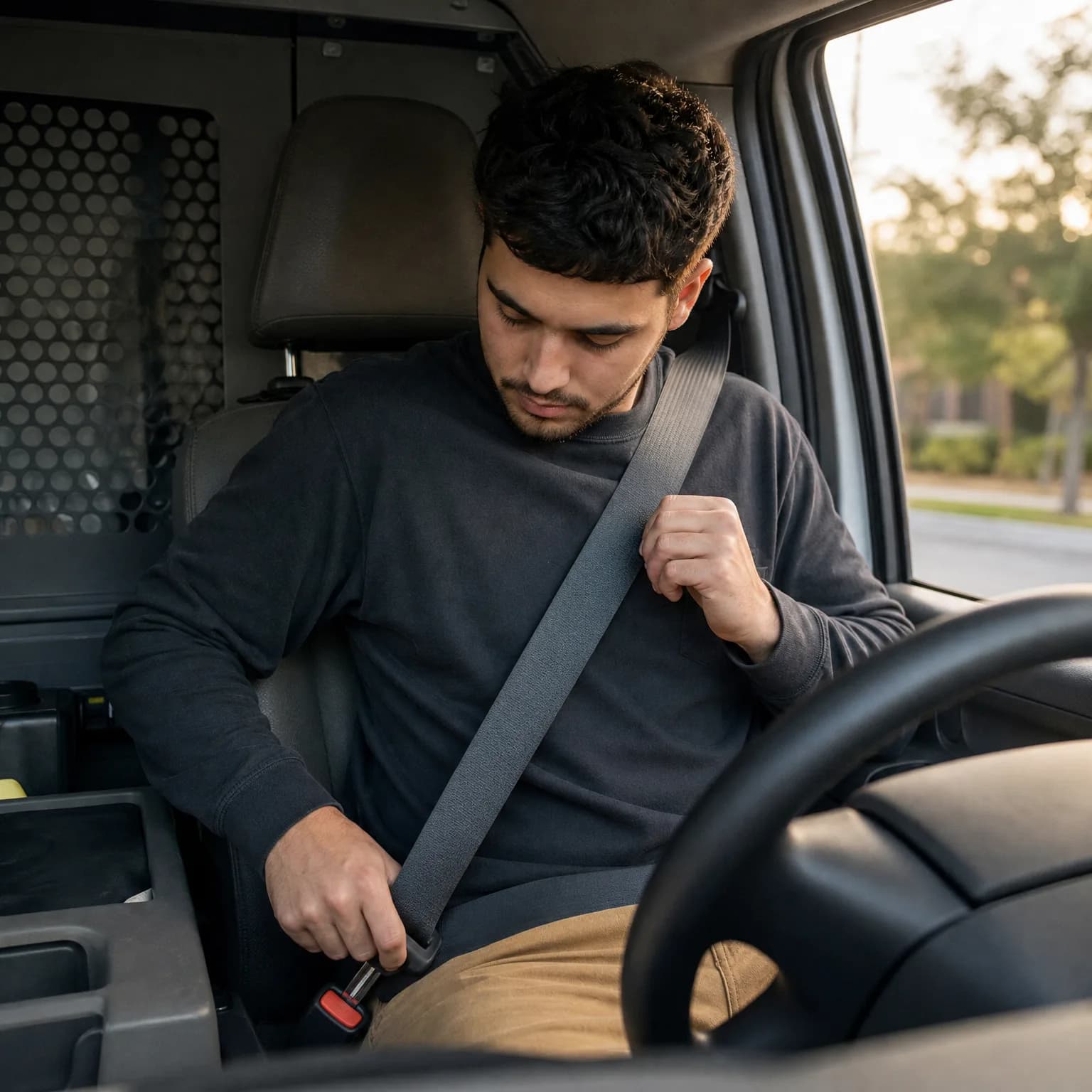
When SR-22 Status Becomes Relevant to an Employer
SR-22 filing status becomes relevant only if the employer is adding you to a company auto insurance policy. At that point, the carrier underwrites you individually and may request proof of prior coverage, claims history, and current policy details. If you are required to maintain SR-22, the carrier sees that filing when they request your insurance history from your current provider.
Some employers reimburse mileage or allow employees to use personal vehicles for work errands under a non-owned auto liability policy. Those policies require the employee to carry their own liability coverage at or above the company's minimum threshold — typically $100,000/$300,000 or higher. If you carry only your state minimum liability (often $25,000/$50,000 because you are on a high-risk policy), you may not meet the employer's coverage requirement even though your license is valid.
If you are required to maintain SR-22 and you drive for work, confirm with your carrier that your policy meets the employer's minimum liability limits. Standard high-risk policies often sell state minimum coverage to keep premiums low, but that leaves you underinsured for employer use. Increasing your liability limits to $100,000/$300,000 typically adds $20 to $40 per month depending on your state and violation profile.
Frequently Asked Questions
Do employers see SR-22 filings on background checks?
No. SR-22 is an insurance filing between your carrier and the DMV — it does not appear on criminal background checks or standard employment verification. Employers see the violation that triggered the SR-22 (DUI, suspension, reckless driving) when they pull your Motor Vehicle Record, but not the filing itself.
Can I be denied a job because I have SR-22?
Not directly. Employers cannot see your SR-22 status unless they request your insurance history as part of adding you to a company auto policy. You can be denied for the underlying violation (DUI, suspension) if it appears on your MVR and disqualifies you under the employer's insurability standards.
Do I have to tell my employer I need SR-22 insurance?
Only if the application asks about violations, suspensions, or license status — then you answer about the underlying event, not the filing. If you will drive a company vehicle or be added to the employer's auto policy, the insurance carrier will see your SR-22 requirement during underwriting.
What shows up on an MVR that employers pull?
Your Motor Vehicle Record shows violations, convictions, at-fault accidents, license suspensions, reinstatement dates, and current license status for the lookback period requested (typically 3 to 7 years). It does not show your insurance carrier, SR-22 filing status, or premium costs.
Can I lose my job if my SR-22 lapses?
If your SR-22 lapses, your license suspends immediately in most states. If your job requires a valid license and you can no longer legally drive, that may be grounds for termination depending on your role and state employment laws. Maintaining continuous SR-22 coverage is critical if you drive for work.
Related Articles

SR-22 and Employer Screening: What Shows on Your MVR
5/17/2026

Will SR-22 Show Up on a Background Check?
5/17/2026

SR-22 and Security Clearance: What Gets Reported
5/17/2026

Will SR-22 Show Up on Carfax or Vehicle History?
5/17/2026

Will SR-22 Affect My Insurance Score With Other Carriers?
5/17/2026

SR-22 and Custody: Do You Disclose Insurance Violations?
5/17/2026